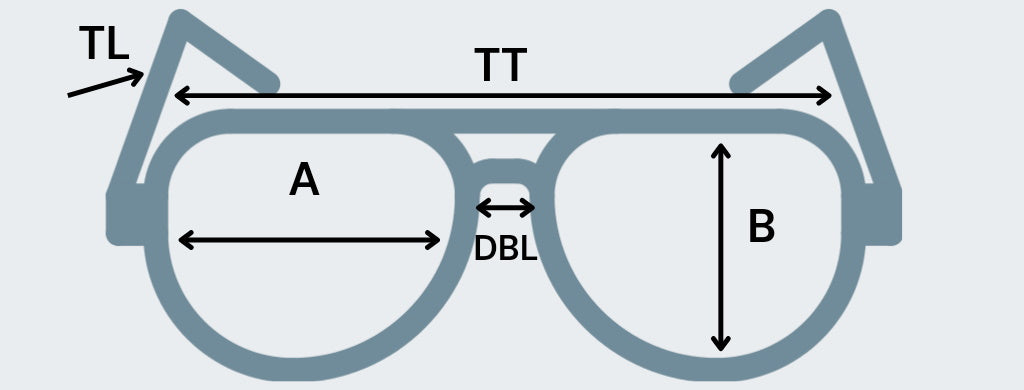
We often hear customers say "I wear a 49 size so looking for glasses that have a 49 size".
Unlike shoe or clothing sizes, eye size, or what we call the "A" has nothing to do with "size". It is merely an industry term we use to determine whether a prescription will work in a given frame or not. While there is some correlation to "size" most people confuse the terminology "eyesize" with "fit".
Let's delve into what "eyesize" really means, and how you can best measure for fit when shopping for sunglasses and sports glasses online.
What Does EyeSize Mean in Glasses?
Eyesize is the distance across one lens at its widest point, measured in millimeters (mm).
Again, it is an optical term that just helps us determine:
-
Whether your prescription will work in that frame based on your PD (pupillary distance)
-
Whether the lens will be too thick either to stay in the frame, or if it will be so thick cosmetically that you want to dissuade a patient from picking this frame.
Just because the word "size" is in there, doesn't mean it is "fit". Think of John Lennon glasses. They were super small and round, but he didn't necessarily have a tiny head, just a smaller "eyesize" on the glasses. The lens diameter was small, but the frames had parts that jet off from the side of the lens before going back over the ear. This is how you can have a small "eyesize" but have it fit a bigger head.
What Is DBL?
DBL means "distance between the lenses" measures the space between the two lenses — essentially the bridge.
Together, A + DBL help determine:
-
Prescription compatibility and lens thickness
-
Width of the frame from one lens to another, but again, that doesn't necessarily mean "fit"
What Measurement Is Best to Determine Fit?
Temple-to-Temple (TT) Width
There is a lesser know measurement called TT or "temple to temple". This does measure exactly as it sounds: it is the distance between one temple (or earpiece) to the other temple. Or some people call the earpieces the "arms" of the glasses. They all mean the same thing. The "opening" that will go between your ears is what is important for "fit". TT measure the actual "opening" of the glasses between the sides of the head and what will best help you determine fit.
TT tells you:
-
Whether the frame will feel tight or loose
-
Whether it will sit comfortably and not put pressure on the side of the head
-
Whether it matches the width of your current glasses
When available, TT is the best measurement to compare between frames.
Many of our Prescription Sunglasses list TT measurements for accurate fit comparison.
Sunglasses and Sports Glasses Further Confuse Eyesize and Fit
Since we sell mostly sunglasses, sports goggles and safety eyewear, this "eyesize" issue further confuses people. As we mentioned, "eyesize" measures the distance across one lens. But if that lens is curved, like most sunglasses and sports glasses are, then the "eyesize" is going to be much larger than a flat pair of eyeglasses.
Curved or wrapped sport frames often have:
-
Larger lens surface area (thus a larger eyesize)
- More coverage or wrap, resulting in a larger eyesize
But the larger eyesize does not necessarily mean they fit wider.
For example:
-
A flatter 52mm eyeglass
-
A wrapped 70mm sunglass
could have nearly identical frame openings (temple to temple measurements)
The curve increases lens width as it wraps around the face. But it doesn't mean the "fit" is larger.
Take anything curved you have around the house. A soda pop bottle, a can, or something like that. Put a fork, chopsticks or anything else straight and flat against the side of that curved can. Measure that distance. Then measure again around the can to the side where you put the straight object. See a difference in the measurement? That is because something curved is bigger than something flat. This is the same concept for sports glasses. This is why if you wear a 49 eyesize regular eyeglasses and order a 49mm sports goggle, you'll find out they don't fit. A 49 eyesize sports goggle is meant for kids ages 5-7. An equivalent size for a small adult would be a 53-54 eyesize sports goggle, again due to the wrap or curved lens.
For more on this, see our video on how to measure an eyesize. You can watch us measure a 49 eyesize, a 54 eyesize and a 70 eyesize and see they all have the same temple to temple width.
Measuring Your Glasses for Temple to Temple Measurement
When measuring at home you want to measure the distance from where the one earpiece (temple) meets the front of the glasses (where the screws go into the arms) to the other side (exact same spot, just the other side). Just make sure to:
-
Use a rigid ruler (nothing that flexes or bends as this will give you an inaccurate measurement)
- Measure in millimeters (mm) for a more accurate measurement as most TT measurements will be given in mm
What Is Temple Length (TL)?
Since we are the topic of measuring, you'll usually see one more measurement.: TL. This is the "temple length" . This refers to how long the earpiece (or temple) of the glasses are.
This matters for:
-
Comfort behind the ear
-
Whether you have what we call "short" or "long" distance to the ears, and how they will fit on the ear
However, this is where people can go wrong with sizing as well.
-
Straight temples are shorter because they don't wrap around the ear
-
Bent/hooked temples must be longer to wrap behind the ear
Thus, a 140mm bent temple may actually wear shorter than a 130mm straight temple.
Temple length should always be interpreted based on the temple design.
For help choosing the right fit, contact the SportEyes team via phone or chat — we’re always happy to compare measurements with you.
FAQ
What is eye size in glasses?
Eye size (A measurement) is the width of one lens at its widest point. It helps determine prescription compatibility but does not determine overall fit.
Does bigger eye size mean bigger glasses?
No. Curved and wrapped lenses often have larger eye size numbers but do not fit wider on the face.
Why do sunglasses have larger lens numbers?
Sunglasses often use curved or wrapped lenses, which increases surface area without increasing frame width.
What is temple-to-temple measurement?
Temple-to-temple (TT) measures the inside width of the frame and is the best indicator of how glasses will fit.
How should I measure glasses at home?
Measure frames flat using a rigid ruler. Do not measure along the curve of the lens.