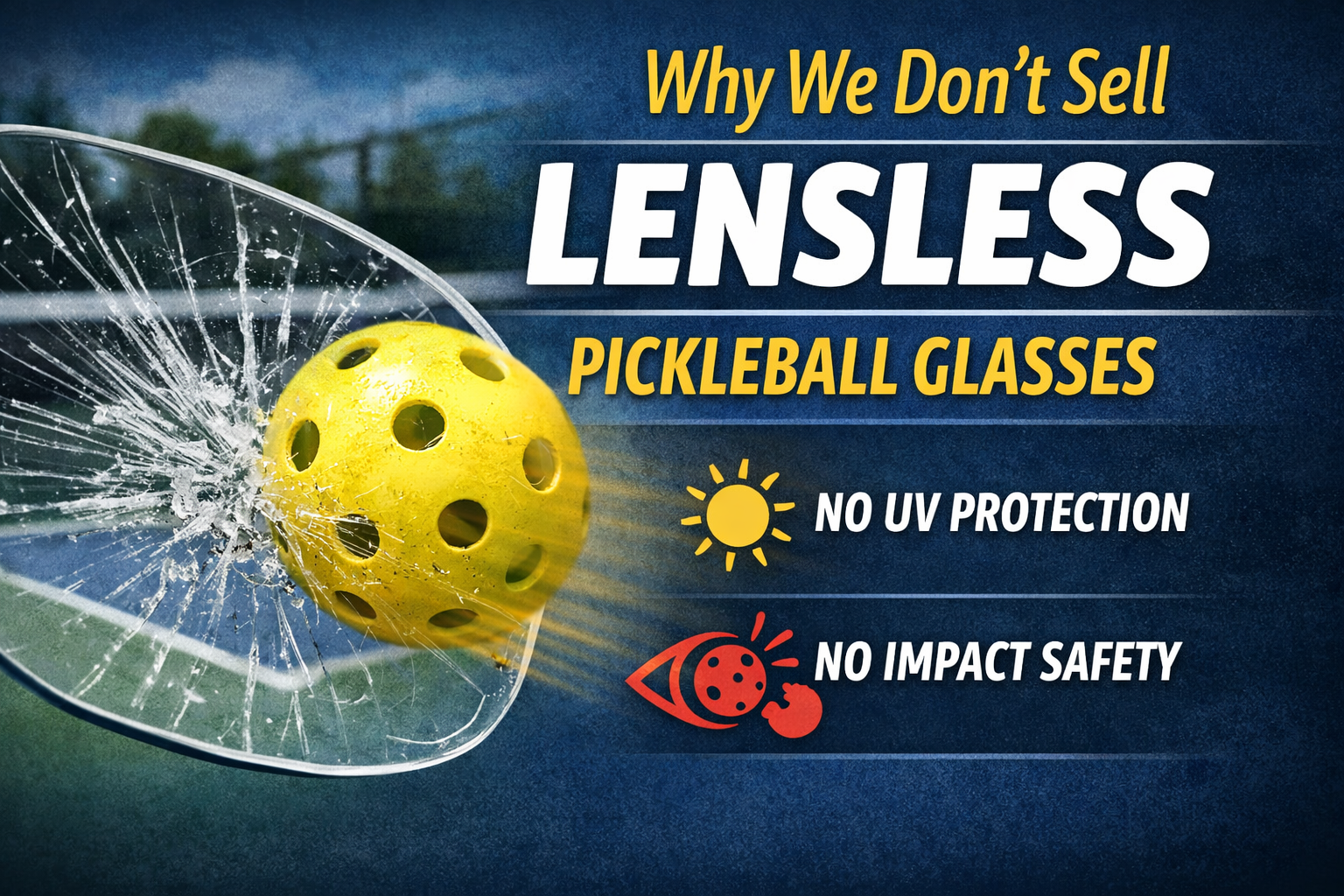
Lensless pickleball glasses seem to be all the rage. So why doesn't A Sight for Sport Eyes sell them?
Short answer: We don't believe lensless pickleball glasses do not provide adequate eye protection. They offer no UV protection and no physical barrier to prevent a ball or paddle from reaching the eye.
A Sight for Sport Eyes was founded because the owner's brother suffered unrepairable eye damage from a baseball. Since then, it our mission to protect the eyes. This means we only carry eyewear proven to actually protect athletes’ vision. So far, none of the lensless pickleball glasses have been able to get ASTM certification which is the authority on ball sport eye protection. We've seen pro pickleball players that have been sidelined for weeks because of "sunburnt" eyes. From an impact and UV protection standpoint, the lensless don't stand up to our tests for "protection" That’s why we don’t sell or promote lensless pickleball glasses.
Lensless may look like they protect, but here's why we are still not convinced.
Pickleball Eye Injuries Are Increasing
As pickleball participation grows, so do eye injuries. Ophthalmologists continue to report injuries such as:
-
Corneal abrasions
-
Hyphema (bleeding inside the eye)
-
Retinal trauma
-
Orbital fractures
Most occur from:
-
Direct ball impact
-
Close-range deflections
-
Paddle contact with the eye
Protective eyewear exists to reduce these risks — but only if it the eyewear has been tested to withstand the impact.

What Real Pickleball Eye Protection Must Do
To protect the eye during pickleball, eyewear must:
-
Create a continuous barrier between the eye and the ball
-
Absorb impact from fast, unpredictable shots
-
Block UV radiation during outdoor play
This is why eyewear certified for ball sports use polycarbonate lenses. Polycarbonate lenses are designed to absorb impact and offer UV protection.
Why Some Players Choose Lensless Glasses
The most common reason players choose lensless glasses is simple:
They don’t fog.
Without a lens, there is no surface for condensation to form. Players who have struggled with fogging during intense rallies or humid conditions find that appealing.
Fogging can:
-
Obstruct vision
-
Interrupt play
-
Cause players to remove their glasses mid-match
That frustration is real.
But eliminating the lens eliminates protection.
You Can Prevent Fogging Without Removing Protection
Fogging is solvable. Modern sports eyewear addresses it through:
Anti-Fog Coatings
Factory-applied treatments reduce moisture buildup on the lens surface.
Anti-Fog Sprays, Gels, and Wipes
These reduce surface tension so condensation spreads thinly instead of forming droplets.
Proper Ventilation
Vented lenses and airflow channels reduce moisture accumulation inside the frame.
Fog-Free Shouldn’t Mean Protection-Free
It’s completely understandable that players want clear vision and no fog. But the solution shouldn’t be to eliminate the protective barrier entirely.
You wouldn’t remove your car’s windshield to prevent it from fogging.
At A Sight for Sport Eyes, we focus on eyewear that solves the fog problem without sacrificing protection.
Because clear vision matters — but protected vision matters more.
See anti-fog solutions for sports eyewear → /anti-fog-solutions

UV Exposure Is a Serious Risk in Pickleball
Pickleball is primarily played outdoors. Cumulative UV exposure to the eyes can contribute to:
-
Pterygium (“surfer’s eye”)
-
Cataracts
-
Corneal damage
Professional pickleball players have been sidelined due to these types of eye injuries that often go unnoticed.
UV protection requires lenses that block 99–100% of UVA and UVB rays.
A frame without lenses cannot provide that protection — at all.
Read our blog for more about UV-protection
“Safety Rated” — What Does That Actually Mean?
Some lensless eyewear is marketed as “ANSI safety rated.”
Understanding what that means is important.
ANSI Z87.1 — Occupational Safety
The American National Standards Institute (ANSI) Z87.1 standard was developed primarily for:
-
Industrial workplaces
-
Construction sites
-
Lab environments
-
Protection from flying debris
ANSI testing evaluates:
-
High-velocity small particle impact
-
Drop-ball impact
-
Optical clarity
-
Basic coverage
ANSI Z87.1 is a legitimate safety benchmark — but it was designed for workplace hazards.
ASTM F803 — Ball Sports Impact
The ASTM International F803 standard was developed specifically for:
-
Racquet sports
-
Ball sports
-
High-speed projectile impacts
ASTM F803 testing evaluates:
-
Direct ball-to-lens impact
-
Ball deformation under force
-
Sports-specific projectile speeds
-
Coverage appropriate for athletic movement
Pickleballs are compressible and can deform on impact. That is why a sports-specific standard exists.
ANSI and ASTM test different types of hazards.
Why the Standard Matters
When eyewear is labeled ANSI Z87.1 compliant, that does not automatically mean it has been tested against:
-
A deforming pickleball
-
Close-range deflected impact
-
Ball-sport projectile forces
Pickleball is a ball sport.
For that reason, sports-specific testing standards are more directly relevant to the type of impact players face.
At A Sight for Sport Eyes, we prioritize eyewear built and tested for athletic use — not just occupational debris.
And while the countless "safety tests" performed by the lensless frame companies, none of them have shown how they stop a paddle or even fingers from your partner from going into the eye (yes this has happened).
Without a solid lens in front of the eye, there is no physical barrier preventing contact. A frame alone cannot stop what it doesn’t block.
This matters because eye injuries don’t require extreme force —as mentioned a finger or a corner of a paddle to the eye can cause serious damage. We haven't seen any "tests" performed by the lensless frame companies that address paddle or finger contact to the eye. They've tested the ball, but the ball is not the only object that is on the court.
See our blog on Why polycarbonate lenses matter for sports for more information.

What We Recommend Instead
We focus on pickleball eyewear that includes:
-
Impact-resistant polycarbonate lenses
-
Full eye coverage
-
100% UV protection
-
Prescription and non-prescription options
Shop pickleball eyewear designed for real protection
Our Bottom Line
Fogging is frustrating. Lightweight frames feel comfortable. Minimal designs look appealing.
But when it comes to vision, protection matters more than minimalism.
Frames without lenses may reduce fog — but they also remove the very barrier that protects your eyesight from impact and sun damage.
At A Sight for Sport Eyes, we believe eye protection should actually protect.
FAQ
Frequently Asked Questions About Lensless Pickleball Glasses
Do lensless pickleball glasses protect your eyes?
In our opinion, lensless pickleball glasses do not provide full eye protection. Without lenses, they cannot block UV rays or prevent direct ball or paddle impact from reaching the eye.
Why doesn’t A Sight for Sport Eyes sell Lensless eyewear?
We don’t sell lensless because they haven not been proven to protect from paddles or fingers to the eyes, and do not provide UV protection . We only offer eyewear designed to protect against both impact and sun exposure.
Is UV protection important for pickleball?
Yes. Pickleball is usually played outdoors, and cumulative UV exposure can cause serious eye damage. Proper UV protection requires lenses that block 99–100% of UVA and UVB rays.
What is the best eyewear for pickleball?
The best pickleball eyewear includes impact-resistant polycarbonate lenses, full eye coverage, and UV protection. Both prescription and non-prescription options are available.