Some of the most meaningful feedback we receive about prescription swim goggles is hearing a parent say, “I can finally see my kids while I’m in the pool,” or learning that a child now feels comfortable getting into the water because they can actually see what is around them.
For someone who normally wears glasses, taking them off at the pool can mean more than slightly blurry vision. The pool edge, steps, lane markers, instructors, family members and other swimmers may all become difficult to see. For children especially, that uncertainty can make swimming lessons or even playing in the water feel intimidating.
The right prescription swim goggles can change that experience. They can help a swimmer feel safer, more independent and more confident—whether that means following an instructor during swim lessons, seeing the pace clock during training or simply keeping an eye on the kids during a family day at the pool.
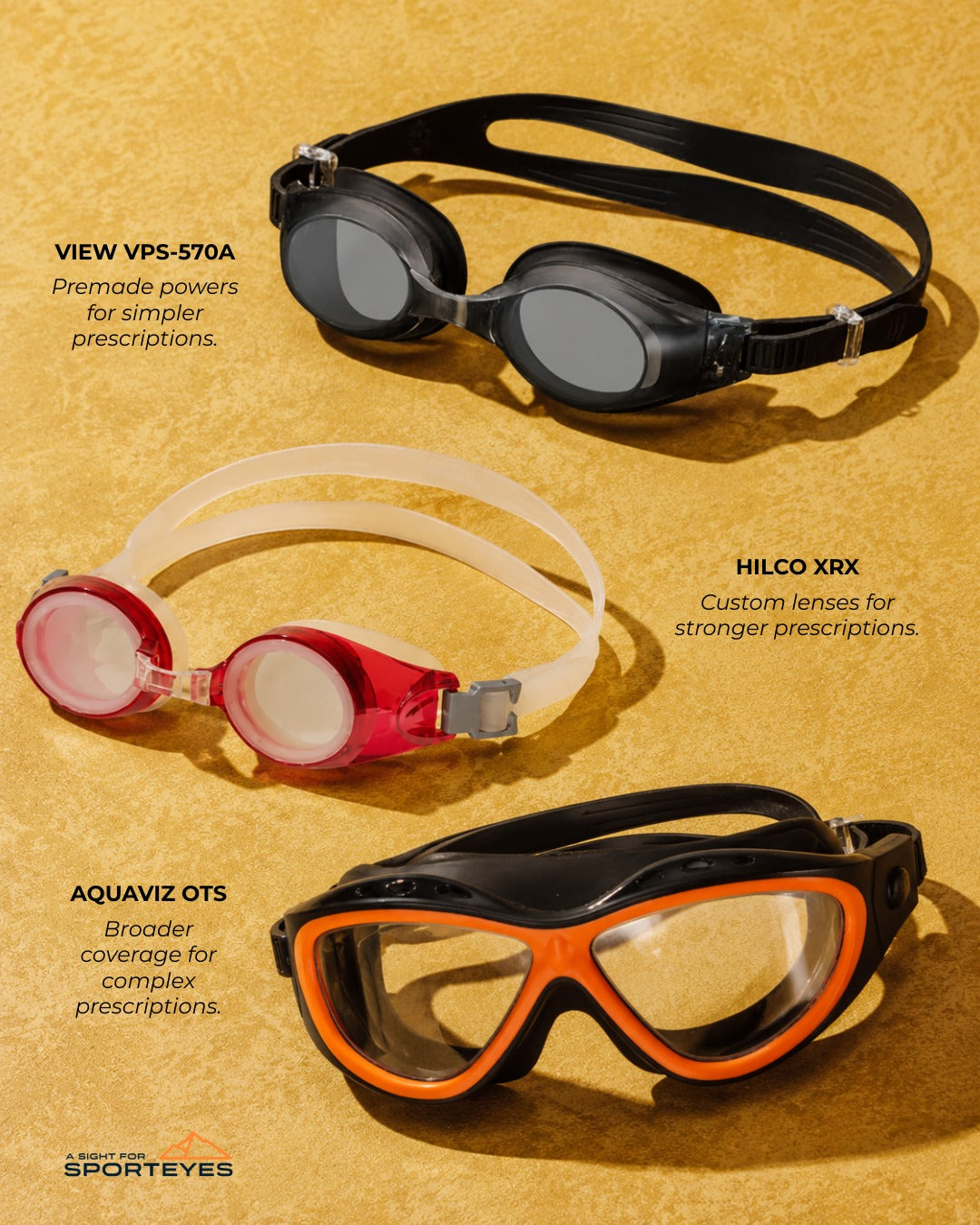
But not all prescription swim goggles provide the same type of vision correction. Some use affordable, ready-made lens powers, while others are custom-made to correct astigmatism, prism, strong prescriptions or significant differences between the two eyes. The best choice depends on your prescription, the level of clarity you need, the shape of your face and where you plan to swim.
This guide will help you understand those options and choose prescription swim goggles that provide the right combination of clear vision, comfort and a watertight fit.
Quick Answer: Which Type Should You Choose?
|
Option |
Often Works Best For |
Important Limitations |
|
Step-diopter goggles |
Mild to high sphere prescriptions, little astigmatism, recreational or lap swimming, and budget-conscious shoppers. |
Similar to off the shelf reading glasses, step diopter goggles only correct close to the prescription, not always exact. Don't expect vision to be perfect. |
|
Custom prescription goggles |
Astigmatism, prism, stronger or complex prescriptions, or swimmers who want vision closer to their everyday glasses. |
Cost more, take longer to make and custom lenses generally cannot be returned. |
|
Prescription swim mask |
Open-water swimming, snorkeling, larger facial coverage or swimmers who prefer a roomier seal. |
Bulkier than a traditional racing or lap-swim goggle which can increase drag. |
Step 1: Start With Your Current Prescription
Use a current eyeglass prescription when ordering prescription swim goggles. Your prescription may include several values. In the simplest terms:
Sphere, or SPH, corrects nearsightedness or farsightedness.
Cylinder correct astigmatism
Axis is the placement of the astigmatism (think of a protractor).
Prism helps correct issues with double vision.
Add power is the extra near correction used in bifocals or progressives.
Pupillary distance, or PD, helps center the "sweet spot" of the lens in front of the pupil.
If your prescription is old, your vision has changed or you are experiencing headaches or eyestrain, schedule an eye exam before investing in prescription swim goggles.
Step 2: Decide Between Step-Diopter and Custom Lenses
Ready-Made Step-Diopter Prescription Goggles
Step-diopter goggles use "off the shelf" pre-made lenses in set powers. They are usually the most affordable option and are often available sooner than custom lenses. Most of these stock goggles are sold in "parts" so you can order the right and left lenses separately, which is important if your eyes do not have the same prescription. You order the lens for each eye, and strap kit to assemble it all together.
Step-diopter lenses can be a practical choice when your prescription is primarily sphere power and your astigmatism is low. Our rule of thumb is if your cylinder (2nd column of the prescription) is less than -1.00, you are a good candidate for the step diopter goggles. They can provide enough clarity to swim laps, recognize people and move safely around the pool, even though the vision may not be identical to what you experience in your everyday glasses.
For step diopter goggles, you want to do a little math before picking a sphere power. Take 1/2 of the cylinder power and add it to the sphere, then round down. Use algebra. If you have + sign on the sphere or cylinder, subtract. If you have the same sign on both sphere and cylinder, add.
A step-diopter option may not be the best choice when:
Your prescription has an astigmatism over -1.50. This is the point where we see most people need the astigmatism corrected.
You have prism or another complex correction.
Your prescription is above +8.00 or -10.00 as this is the maximum the step diopter goggles come.
You need sharper, more precise vision for training, competition or open water.
Custom Prescription Swim Goggles
Custom prescription swim goggles are made using your actual prescription rather than the nearest available stock power. Depending on the goggle and prescription range, custom lenses may correct sphere, cylinder and axis for astigmatism, and some designs can also accommodate prism. This makes custom goggles the better starting point for many high or complex prescriptions.
As astigmatism increases, the remaining blur becomes more noticeable. If seeing clearly matters more than simply being able to navigate the pool, choose a custom option that corrects the cylinder and axis.
If you have prism, custom made is the only option that will correct prism. Some custom made goggles can only correct so much prism. Check with on our team if you have more than 2 diopters of prism on which goggles will work for your RX.
Custom lenses generally provide vision closer to your everyday glasses, but they cost more and require longer production times. Because the lenses are made specifically for you, they are normally nonrefundable. We strongly recommend ordering goggles for fit before custom lenses are made.
Step 3: Choose the Right Fit Before Focusing on the Prescription
Even perfect prescription lenses will not make the wrong goggle comfortable or watertight. Fit is personal, and adult versus youth sizing is only a starting point. Face width, eye-socket shape, nose bridge and the softness of the gasket all affect the seal.
To check a goggle before entering the water, press the eye cups gently against your face without putting on the strap. A suitable goggle should create light suction and remain in place briefly. If it releases immediately, presses painfully on the nose or sits on the eye itself, try a different bridge or goggle shape.
The strap should hold the goggle in position, not create the entire seal. Overtightening may cause headaches, deep marks and discomfort without solving a poor fit. For children, choose a true youth size when needed rather than tightening an adult goggle as far as it will go.
Most of the goggles come with different sizes or adjustable nose bridges. If you can't get a good fit at first, try a different nose bridge, rather than just making the goggles tighter.
Step 4: Match the Lens Color to Where You Swim
|
Lens Type |
Best Use |
What to Know |
|
Clear |
Indoor pools, low light and evening swimming |
Lets in the most light and keeps colors natural. |
|
Smoke or tinted |
Bright indoor pools and outdoor swimming |
Reduces overall brightness and can be more comfortable in sun. |
|
Mirrored |
Bright outdoor pools and strong glare, backstrokers |
Reflective finish reduces brightness and offers a sportier appearance; it may feel too dark indoors. |
|
Blue or colored tint |
Mixed lighting, depending on tint depth |
Can soften glare or enhance comfort, but performance varies by color and darkness. |
Outdoor swimmers should also look for UV protection.
What about Polarized?
Polarized lenses reduce glare reflected from flat surfaces, but they work best when you are viewing that surface from an angle. When your head is at or just above the water’s surface, there may not be enough of an angle for polarization to provide a noticeable benefit. If you will mainly be lap swimming or staying at water level, polarized lenses may be an unnecessary expense. They can be more useful when you are positioned above the water or using the goggles for activities such as kayaking, paddleboarding or other surface water sports where reflected glare is more noticeable. Polarization is also available in only certain custom-made prescription goggles, so not every goggle can be ordered with this option.
Step 5: Think About How You Will Use the Goggles
Lap Swimming and Fitness
Look for a secure low-profile fit, a soft but stable seal, anti-fog treatment and a double strap that stays in place during turns. A step-diopter goggle may be sufficient if your prescription is straightforward.
Competition and Triathlon
Prioritize a stable seal, wide enough peripheral vision and a streamlined shape. Open-water athletes may prefer a larger viewing area or a swim mask, especially when sighting buoys and monitoring nearby swimmers. Test the goggle during training rather than wearing a new pair for the first time on race day.
Recreational Swimming and Water Activities
Comfort and a broad field of view may matter more than a minimal racing profile. A larger goggle or prescription swim mask can be a good choice for casual swimming, snorkeling and surface water sports. A swim goggle or swim mask is not automatically suitable for scuba diving; use a purpose-built prescription dive mask for depth and pressure.
Children
Choose a youth-sized goggle with an easy-to-adjust strap and nose bridge. Children should be able to put the goggle on without excessive tightening. Because children’s prescriptions and facial dimensions can change, replace the goggle when the prescription is no longer current or the seal no longer fits comfortably.
Anti-Fog Care and Goggle Maintenance
Most quality swim goggles include an anti-fog treatment, but the coating can be damaged by rubbing the inside of the lenses. To help the goggles last:
Rinse them with clean, cool water after swimming.
Do not rub or wipe the inside lens surface unless the manufacturer specifically says it is safe.
Let the goggles air-dry away from direct sunlight and high heat.
Store them in a protective, ventilated case once dry.
Avoid leaving them in a hot car or loose in a swim bag where the lenses can be scratched.
Use only an anti-fog product approved for swim goggles and follow its directions.
Rinsing also helps remove chlorine and salt that can shorten the life of the strap and gasket. Replace worn straps, bridges or gaskets when replacement parts are available rather than waiting for the goggle to fail at the pool.
Can You Swim in Contact Lenses?
Water can expose contact lenses to microorganisms and may cause a lens to tighten, move or trap contaminants against the eye. Many eye-care professionals advise against swimming in contacts. If your doctor has told you to use contacts in the water, wear well-sealing goggles and follow the doctor’s instructions for cleaning or disposing of the lenses afterward. Prescription swim goggles avoid the need to wear contacts while swimming and are often the more comfortable long-term solution.
Common Buying Mistakes
Ordering the sphere number without accounting for cylinder or the lens powers actually offered.
Assuming both eyes need the same power.
Choosing an adult goggle for a child and relying on an overtightened strap.
Ordering custom lenses before checking that the frame seals and feels comfortable.
Selecting mirrored or dark lenses for a dim indoor pool.
Treating a swim goggle as a substitute for a pressure-rated dive mask.
Rubbing the inside of the lenses and damaging the anti-fog coating.
What Information Do You Need to Order?
Have the following ready before you choose a goggle:
Your complete, current prescription for both eyes.
Your PD for custom lenses, if requested.
The swimmer’s age and whether a youth or adult fit is needed.
Where the goggles will be used: indoors, outdoors, open water or competition.
Any history of leaking, pressure around the eyes or difficulty fitting the nose bridge.
Your deadline. Ready-made lenses typically arrive sooner than custom prescription work.
If you are uncertain, send us the entire prescription rather than choosing a lens power on your own. Our opticians can review the numbers, explain which goggles are compatible and help narrow the options before custom lenses are made.
Frequently Asked Questions
Can prescription swim goggles correct astigmatism?
Yes, custom prescription swim goggles can correct astigmatism when the selected model supports your cylinder and axis. Most step-diopter goggles do not directly correct astigmatism.
Can I order a different power for each eye?
Many modular step-diopter goggles and custom goggles allow different right and left prescriptions. Some pre-made models require matching powers, so check the product options before ordering.
Do prescription swim goggles work for farsighted prescriptions?
Yes. Plus-power step-diopter and custom options are available, although the available range varies by model. Custom lenses may be needed when the plus prescription is strong or includes astigmatism or prism.
Can prescription swim goggles include bifocals or progressives?
Most swimmers need distance correction in the water, and conventional step-diopter goggles are distance-only. Specialty near or multifocal solutions may be possible in selected custom designs, but they are not available in every goggle. Tell us what you need to see, such as a watch, dive computer or poolside instructions, so we can evaluate the safest and most practical option.
How clear will step-diopter goggles be?
That depends on your prescription. Swimmers with mostly spherical correction and little astigmatism may see very well. If a meaningful part of your prescription is left uncorrected, the goggles can improve vision without matching the sharpness of everyday glasses.
Should I try the goggle before ordering custom lenses?
Yes, whenever possible. A custom prescription cannot correct a goggle that pinches, leaks or does not match your face. Trying the nonprescription frame first helps reduce the risk of investing in nonrefundable custom lenses in the wrong fit.
The Bottom Line
Choose the goggle for your prescription and your face, not just the color or price. Step-diopter swim goggles are an affordable, effective solution for many straightforward prescriptions. Custom prescription swim goggles are worth the additional cost when you have astigmatism, prism, strong powers, a substantial difference between your eyes or a need for more precise vision.
At A Sight for Sport Eyes, we specialize in prescription sports eyewear and work with prescriptions that many general retailers cannot accommodate. If you are not sure which swim goggle will work, send us your prescription and tell us where and how you swim. We will help you narrow the choices before you order.
Shop all prescription swim goggles
Prescription information and help reading your prescription